

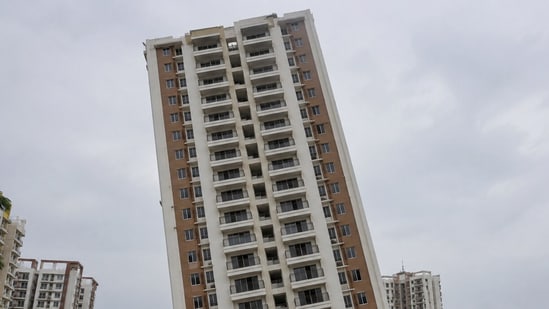
The voluntary demolition of an 18-storey residential tower in Bengaluru by real estate developer SNN Raj Corp, even when the project had received an occupancy certificate (OC) and was almost ready for handover before the demolition was developed, is an ‘unprecedented case’, Karnataka Real Estate Regulatory Authority Chairman Rakesh Singh told HT Real Estate.
However, Singh said the developer is unlikely to require new project registration. Instead, the project may be given an extension of one year under Section 6 of the Real Estate (Regulation and Development) Act, with the possibility of further extension if necessary.
“This can provide legal cover to the developer to complete the project and ensure that there are no problems for his financial institutions,” Singh said.
‘First such case in the country’
Calling it an ‘unprecedented case’, Singh said neither Karnataka RERA nor, to the best of his knowledge, any other RERA in the country has dealt with a situation where an OC-approved residential tower is being voluntarily demolished and rebuilt due to structural concerns.
He said, “As far as I understand, this is the first such experience for us and probably for the country. I also checked with some other Rares and they also said that this is the first case of its kind.”
Singh said the legal process itself is relatively straightforward. Since the registration of the project has expired, the developer can seek an extension of one year under Section 6 of the RERA Act, with the possibility of further extension if necessary.
“Legally, I see no challenge. The provisions under Section 6 of the RERA Act are sufficient to deal with such a situation,” he said.
Home buyer’s interests come first
Although the legal framework is clear, Singh said the regulator’s biggest concern is to protect the interests of home buyers.
“The interests of the allottees start from day one. Many may have planned to shift to their homes, vacate the rented accommodation or have other financial commitments. The developer should adequately compensate those affected by the delay by paying the rent they would otherwise have avoided. For example, if the prevailing rent is ₹They should consider paying Rs 25,000 per month ₹Instead of inviting friction or dispute at this stage, if necessary, Rs 30,000. Give,” he said.
Singh said representatives of SNN Raj Corp had met him two to three times to discuss the legal action and had accepted the regulator’s suggestions.
He said, “…I believe the matter can be resolved easily. It is a matter we will be able to deal with.”
‘The circumstances of every allottee are different’
Singh said he advised developers to adopt a transparent and consultative approach with home buyers instead of imposing unilateral solutions.
“I suggested that all the buyers be called for a meeting and the developers openly discuss the situation with them. Instead of us suggesting a solution, the stakeholders themselves should be actively involved in arriving at a solution,” he said.
He said the impact of the delay will vary from buyer to buyer.
“Some people may be financially comfortable and mentally prepared to wait for two years. Others may be under immense financial pressure, unable to wait because they have EMIs, rent or other commitments. The circumstances of all allottees are different, and this should be kept in mind,” he said.
Also read: Bengaluru Leaning Tower: What home buyers should check besides project brochures?
Commenting on the demolition, Singh said the case does not fall under defect liability provisions as the entire structure will be demolished and rebuilt.
He said, “This has nothing to do with fault liability. The entire building is being demolished and new construction will take place.”
Singh also gave a comprehensive overview of India’s rapidly growing high-rise construction sector.
“Building technology in India has advanced considerably, and we are now constructing 30-, 40-, 60- and even 100-storey buildings. I have my own objections, although I have no theory to support them. In my limited experience, I have rarely seen a building which has no problems within two or three years of completion, be it cracks, leaks or fading. This is the case, however, “Extraordinary because the developer has voluntarily chosen to demolish and rebuild the structure,” he said.
What does Section 6 of the RERA Act say?
Section 6 of the Real Estate (Regulation and Development) Act, 2016, empowers the Real Estate Regulatory Authority (RERA) to extend the registration of a real estate project. A promoter can apply for extension in cases of force majeure by submitting the prescribed application and fee.
This provision also allows RERA to extend the registration of the project depending on the facts of each case, in appropriate circumstances, where the promoter is not responsible for the delay. However, such extension cannot exceed the total period of one year. Before rejecting an application for extension, the authority is required to give an opportunity of being heard to the promoter.
Also read: Bengaluru’s leaning 18-storey residential tower to be demolished by Edifice, the company that demolished the Noida Twin Towers
Bengaluru leaning tower demolition case
SNN Raj Corp had last week announced that it will voluntarily demolish and reconstruct one of the towers at its SNN Raj Eternia project in HSR Layout at no cost to home buyers after it identified structural issues linked to an error in soil testing.
The developer said it has approached the Bruhat Bengaluru Municipal Corporation (BBMP) for permission to demolish the tower and has also informed Karnataka RERA about the error of the external consultant and the decision to reconstruct the structure.
Anuj Sanjay Jain, director (operations), SNN Raj Corp, said the company decided to reconstruct the entire tower after the flaw was discovered.
“We have decided to reconstruct the entire structure. Demolition will take at least six months and reconstruction will take 18 months,” Jain said. ₹200 million.
The company said all affected home buyers have been informed about the decision. Although initially disappointed, he later accepted the offer.
In a statement, SNN Raj Corp said, “Despite the structures having received occupancy certificates and being almost ready for handing over, the developer chose to prioritize long-term structural integrity and customer safety over financial considerations.”
The project comprises 972 apartments, of which possession of 822 units has already been handed over.