

From football matches in society playgrounds to access to club houses and parks and even disputes over flower pots placed in common areas to enhance aesthetics, fights over the use of shared spaces are becoming common in gated communities.
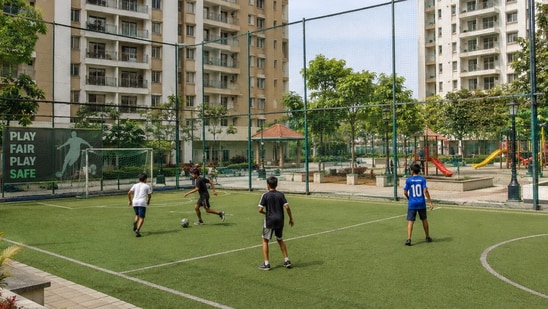
But can an apartment association stop children from playing football just because some residents complain about noise or inconvenience? The Karnataka High Court has responded with a clear message: Apartment associations cannot impose blanket restrictions on the use of common play areas through arbitrary rules.
It added that any restrictions must be supported by the registered bye-laws of the association, follow due process and be reasonable, thereby strengthening the right of residents, especially children, to enjoy shared community spaces.
In his June 16 order, Justice Hanchett Sanjeevakumar set aside a 2021 trial court judgment that had upheld the decision of the Esteem Gardenia Apartment Owners Association in North Bengaluru’s Sahakar Nagar. The case was filed by local residents Sangeeta Agarwal and Hemant Agarwal, who had challenged the association’s decision to ban football and other physical games in the apartment playground, calling the ban arbitrary and unreasonable.
Also read: Can a housing society restrict access of tenants or guests to the club house? MahaRERA clarifies
The association had defended its decision by saying that the ban was based on complaints from some residents and that only games “appropriate for the sports area” were allowed. However, the High Court found this justification vague, noting that the association failed to specify that Games allowed And which were banned.
What does the High Court order say?
The Karnataka High Court has directed the Bengaluru Apartment Owners’ Association to reconsider the ban on children playing football in the society’s playground, holding that a blanket ban on physical sports cannot be imposed through vague rules and emphasizing that children have a right to access common play areas.
The court said, “There is no claim in the written statement of the respondent regarding which sports the children are allowed to play and which are not. Therefore, the statement made in the written statement is vague in nature and no explanation is given in it. In the face of this, the respondent should not stop the children from playing sports in the play area. It is a fundamental right of the children to play sports and stopping the children from playing affects their overall health.”
Although the High Court did not completely nullify the Association’s power to regulate the use of playing fields, it held that an absolute and undefined ban was not sustainable. Instead of ordering football to be allowed immediately, the court directed the association to convene a general body meeting within three months and decide democratically by majority vote as to which games could be allowed or banned in the common playing area. The court said that the association must “take the confidence of the members” by ensuring that children are not deprived of the right to play.
The court directed the Association to reconsider its decision, taken earlier in this regard and with the consent of the majority of the residents of the apartment, “shall decide as to which games are to be allowed in the play area and which are not permitted. However, by barring one or two games, children should not be deprived of playing games in the play area. The respondent shall specify the games to be played in the play area after taking the confidence of the members of the association. The respondent/Association is directed to take a decision in this regard.” “Within a period of three months from today,” it said.
Obstruction of flower pots in common areas
Apart from the playground dispute, the High Court also ruled in favor of the residents on the issue of obstructions in common areas. It overturned the findings of the trial court and issued a mandatory injunction directing the association to remove flower pots and other items placed on the stairs, corridors and other common areas. It also prohibited the association from placing any material in spaces meant for the common use of all apartment owners.
This is what legal experts say
This judgment is likely to have a wide-ranging impact on resident welfare and apartment owners’ associations across Karnataka, indicating that while associations can make reasonable rules for common amenities, sweeping or arbitrary restrictions, especially those affecting children’s recreational rights, must be reasonable, transparent and supported by the collective decision of residents.
Also read: From ₹40,000 ₹50,000 before lease renewal, sparks Reddit debate”>Bengaluru tenant accuses landlord of increasing rent ₹from 40,000 ₹50,000 before lease renewal, debate erupts on Reddit
Corporate legal practitioner Arpita Mukherjee says Residents Welfare Associations (RWAs) and apartment associations cannot impose arbitrary restrictions on the use of common areas like playgrounds, club houses or parks.
She says, “Any restrictions must be in accordance with the registered bye-laws of the association, must be approved through a prescribed decision-making process, such as a general body meeting where necessary, and must be reasonable, non-discriminatory and in line with applicable apartment ownership laws.”
What should home buyers and residents check in the bylaws of the apartment association before purchasing a flat?
She advises homebuyers to carefully check the bylaws of the association before purchasing a flat, paying special attention to the use of common areas and recreational facilities, resident conduct, maintenance obligations, penalties, voting rights and the association’s powers to make or amend rules.
Also read: Karnataka draft apartment bill explained: 75% redevelopment rule, association rights and key proposals for home owners
Can an apartment association stop children from playing football in a designated playground just because some residents complain?
Mukherjee says an apartment association generally cannot stop children from playing football in a designated playground merely because some residents object. Although it may set reasonable rules relating to hours of play, safety measures or noise management, an outright ban may be considered arbitrary unless it is supported by by-laws or justified by genuine safety concerns.
Also read: Noida dog bite case: Can RWAs be held liable for ‘deficiency in service’? Explanation of Consumer Forum order