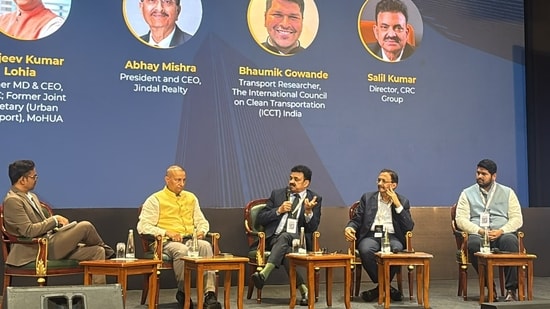
As the National Capital Region (NCR) is witnessing rapid urban expansion, experts believe that the next phase of development will depend not only on new housing and infrastructure but also seamless transport connectivity. At the India Next Real Estate Expo, a panel discussion on “Corridors: Reshaping the growth map of Delhi-NCR” brought together policymakers, transport experts and real estate leaders to discuss how integrated mobility can shape the future of the region.

The panel included Sanjeev Kumar Lohia, former MD & CEO, DMRC and former Joint Secretary (Urban Transport), Ministry of Housing and Urban Affairs (MoHUA); Abhay Mishra, Chairman and CEO, Jindal Realty; Bhowmik Gowande, Transport Researcher, International Council for Clean Transport (ICCT) India; and Sail Kumar, Director, CRC Group.
A frequently repeated theme throughout the discussions was that expanding the metro network alone would not be enough. Experts stressed that the focus now should be on last mile connectivity, integrated transport planning and creating urban centers where people can travel easily without relying too much on private vehicles.
Call to strengthen transport connectivity
Speaking on transport planning, Bhowmik Gowande said India’s urban development model needs a more integrated approach rather than isolated housing projects. He observed that many residential complexes continue to develop without adequate public transport access, leaving residents dependent on private vehicles.
He pointed out that if a single authority oversees planning and implementation, infrastructure can be developed in a more coordinated manner. Citing global examples, Gowande said Tokyo’s dense railway network has helped shape its urban growth, adding that the NCR is almost three times the size of Tokyo and therefore requires even stronger transport planning.
On the Regional Rapid Transit System (RRTS), he said the network could significantly reduce travel time across the region. “We had earlier said that by 2034, people will have easy access to metro stations and will travel faster,” he said. He said that despite being one of the most efficient solutions for urban mobility, buses remain an underutilized mode of public transport.
Sanjeev Kumar said transport planning should start by identifying travel patterns of passengers rather than simply building new infrastructure. Referring to the Delhi-Meerut Regional Rapid Transit System (RRTS), he said planners had initially assumed that a large number of people would travel between Delhi and Meerut.
He also gave an example of why last mile connectivity remains a major challenge despite metro expansion. He said many commuters still take almost an hour to reach the nearest metro station, reducing the overall convenience of public transport.
On increasing metro connectivity
CRC Group Director Sail Kumar highlighted that the metro expansion should be supported by effective connectivity till the first and last mile. He said that although Delhi Metro has changed the commute, many residents still spend almost an hour traveling to reach the nearest metro station.
Using Gurugram as an example, Kumar said transport connectivity should be planned along with urban development and not as an afterthought. He warned that mere construction of more flyovers will not solve congestion if the public transport system remains weak.
“Last mile connectivity needs to be strengthened. If we are serious about building a bigger economy, transport corridors become fundamental,” he said.
He also argued that Delhi’s transformation is more than upgrading infrastructure. “This is not just an adjustment; it is a paradigm shift,” he remarked, adding that projects like the Ganga Expressway and other emerging transport corridors will further improve regional connectivity.
Abhay Mishra, Chairman and CEO, Jindal Realty, stressed the need for integrated urban planning. He emphasized that cities cannot continue to expand through uncoordinated residential development and instead need infrastructure that supports both mobility and economic growth.
The discussion ended with a shared message that the future of Delhi-NCR depends on creating a transport ecosystem where metro rail, RRTS, buses and last-mile connectivity work together. Panelists agreed that as the region continues to grow, well-planned connectivity will be the key to reducing congestion, improving quality of life and unlocking the full potential of NCR’s emerging growth corridors.